
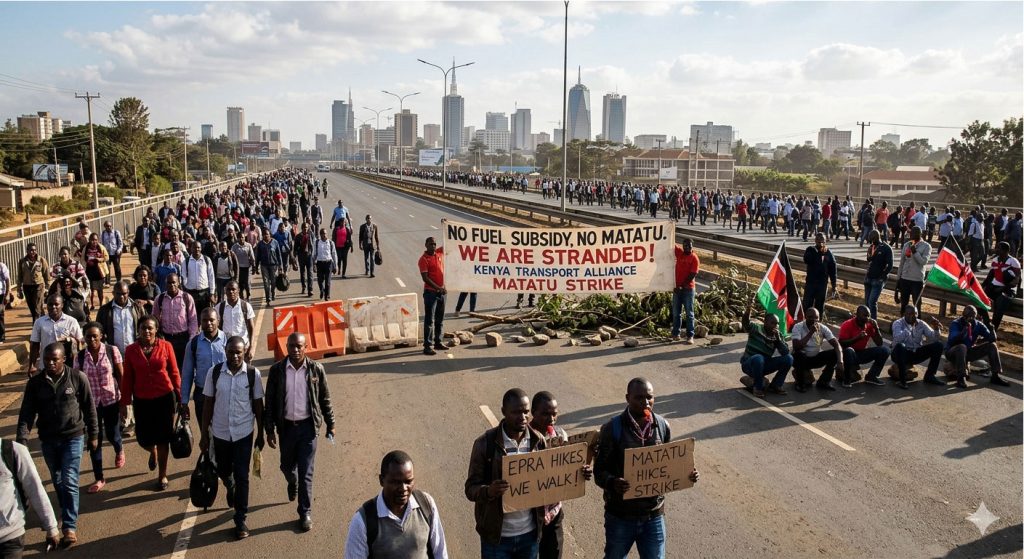
If you tried to catch a ride to work or drop your kids off at school in Nairobi early this week, you were likely met with empty stages, heavily barricaded major highways, and a lot of walking.
The nationwide transport strike paralyzed the country’s transport ecosystem. This was a massive, coordinated industrial action that united matatu operators, digital taxi drivers, truckers, and boda boda riders into a single, unified front.
But to understand the fury boiling over on Kenyan roads, we have to look past the blocked highways and dive straight into the numbers that triggered the chaos.
The Spark: EPRA’s Mid-Month Bombshell
The crisis ignited when the Energy and Petroleum Regulatory Authority (EPRA) dropped its May–June pricing cycle. Driven by a massive 20.3% spike in international landed costs for diesel and volatile geopolitical friction in the Middle East, the regulatory pump prices hit historic, eye-watering highs.
The initial shockwave looked like this in Nairobi:
- Super Petrol: Increased by KSh 16.65, pushing it to KSh 214.25 per litre.
- Diesel: Skyrocketed by a massive KSh 46.29, hitting KSh 242.92 per litre.
For the transport sector—which runs almost exclusively on diesel—this wasn’t just a regular price hike. It was an operational death sentence.
Why the Transport Sector Walked Out
Within hours of the announcement, the Transport Sector Alliance announced a total shutdown and suggested an immediate 50% fare hike to survive.
But the strike wasn’t just about the raw cost of fuel. Transport operators pointed out a glaring anomaly that exposed a massive loophole in the economic system: The Kerosene Gap.
While diesel shot past KSh 242, kerosene was left completely untouched by EPRA at KSh 152.78 per litre—subsidized heavily by the state to protect low-income households. This created a massive KSh 90.14 gap between the two fuels. Operators loudly warned that this massive disparity would force widespread, dangerous fuel adulteration (mixing cheap kerosene into diesel to cut costs), which ruins commercial engines.
The Panic, The Pushback, and The Pivot
The strike took effect at midnight on Monday, May 18. The result? Total paralysis.
- Schools Suspended: The Kenya Private Schools Association (KPSA) advised institutions to halt day-scholar operations, leaving school buses parked.
- Stranded Commuters: Major arteries like Thika Road (the Githurai–Roysambu stretch), Jogoo Road, and Mombasa Road were completely cleared of public service vehicles.
- Tragic Escalation: What was intended to be a peaceful protest turned volatile, with clashes breaking out across various trading centers, resulting in tragic loss of life.
Realizing that a prolonged shutdown would completely tank economic productivity, the executive branch scrambled. Following a directive from the presidency, EPRA did something incredibly rare: they issued an emergency mid-cycle addendum late Monday evening to break the deadlock.
The Current State of Play
To get wheels turning again, the government reallocated stabilization funds from the Petroleum Development Levy to narrow the dangerous gap between fuels. The adjusted emergency prices stand as follows:
| Product | Old May Price | New Adjusted Price | Change |
| Super Petrol | KSh 214.25 | KSh 214.25 | Held Flat |
| Diesel | KSh 242.92 | KSh 232.86 | Reduced KSh 10.06 |
| Kerosene | KSh 152.78 | KSh 191.38 | Increased KSh 38.60 |
By cutting diesel slightly and aggressively raising kerosene, the government squeezed the adulteration gap down to KSh 41.48.
The Ripple Effect: While the KSh 10 drop on diesel was enough to get matatus back on the road and suspend the strike, the economic damage is far from over. The massive hike in kerosene hits low-income households hard, and the elevated diesel price means everything from manufacturing to electricity bills will remain inflated for the foreseeable future.